
The Basics of A Circuit Breaker
- Blog /
The Basics of A Circuit Breaker
Jan 07, 2026
Download as PDFFrom home electrical systems to advanced industrial circuits, circuit breakers protect power systems from electrical power overloads, ground faults, arc faults, and other scenarios where electricity could pose a safety risk to people and property. In the case of a fault, circuit breakers interrupt the flow of electricity, limiting the energy available to cause damage. What types of circuit breakers exist and why? Let’s take a quick look.
How Does a Circuit Breaker Work?
The most common type of circuit breaker consists of an electromagnet and a movable armature with an electrical contactor at the end. The arm is connected to a spring or other actuator. The arm contactor makes contact with a stationary contactor inside the breaker, completing the circuit and allowing electricity to flow. When a problem occurs, the actuator forces the contactors apart, stopping the flow of electricity. The voltage (electrical power standing still), current (voltage moving through a conductor over time), and where the breaker will be installed are the primary factors to consider when choosing a circuit breaker.
Miniature Circuit Breaker( MCB)
MCBs are commonly used in low-voltage applications such as 24 V DC or 125 V AC circuits. These devices have current ratings ranging from 0.5 A to 30 A. Miniature breakers can be found in automobiles, small appliances, and office equipment, among other applications. They typically have a generic mounting system, such as a DIN rail, or are housed inside a control panel.
Molded Case Circuit Breaker (MCCB)
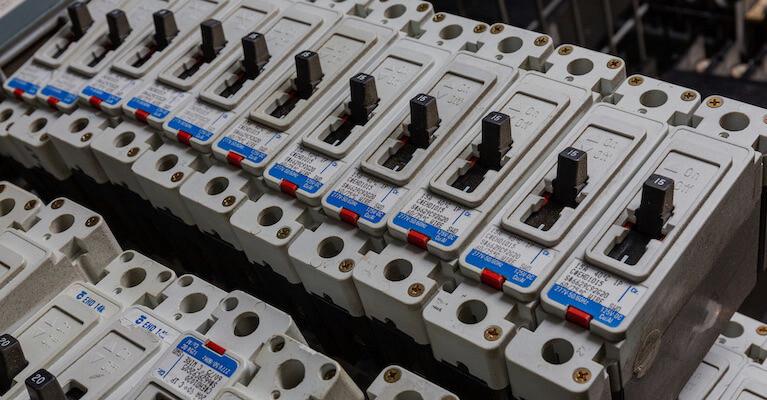
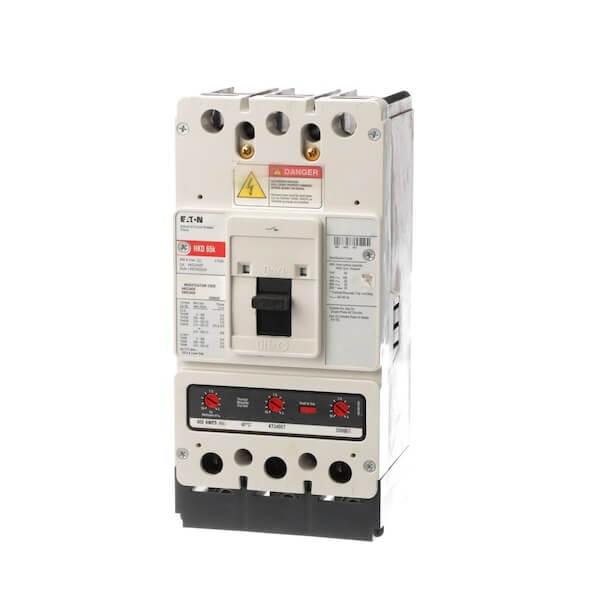
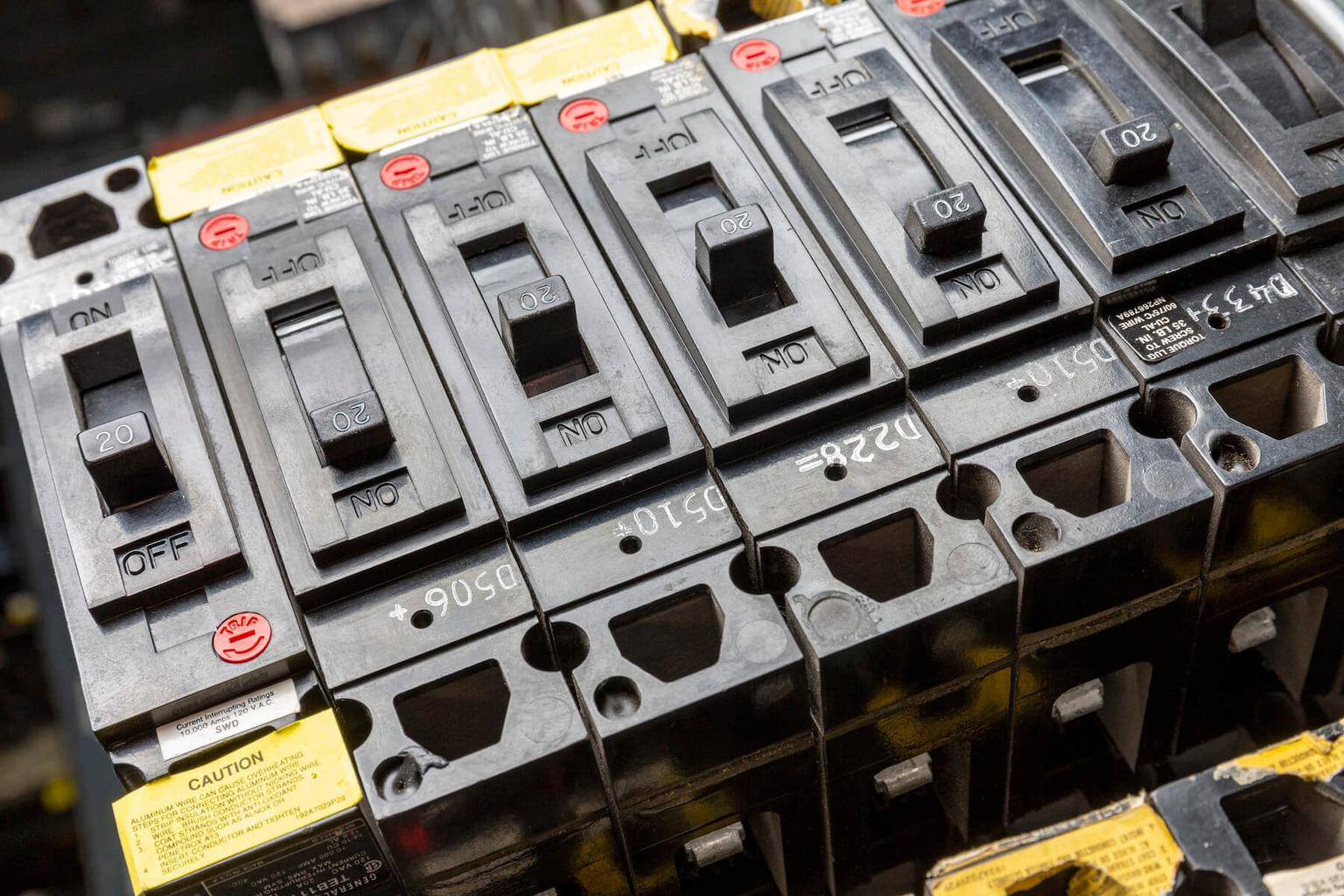
MCCBs are the most common type of circuit breaker. They have higher current-carrying capacity than miniature breakers, ranging from 3 A to more than 4,000 A. In these devices, a thermal-magnetic trip unit typically opens the circuit breaker when the electrical current exceeds the breaker’s rating, causing a metal sensor to actuate, or turn on. [Molded case circuit breakers](https://www.electrical.com/Products/Molded-Case "Molded Case Circuit Breakers") are widely used in residential and commercial applications.
Insulated Case Circuit Breaker (ICCB)
ICCBs are similar to molded case circuit breakers, but unlike MCCBs, insulated case breakers often use an electronic circuit to monitor electrical current and a stored energy mechanism that is usually charged by manipulating a charging handle. They have the functionality of a larger, more capable ironor air-frame circuit breaker or a low-voltage power breaker with a molded plastic frame instead of a metal frame. These breakers, along with the remaining breakers on our list, are regularly reconditioned and returned to service.
Air Circuit Breaker (ACB)
ACBs are the first breakers on our list to move exclusively beyond low voltage (0–0.6 kV) to mediumvoltage power distribution (0.6 kV–33 kV). Unlike the breakers discussed earlier, an ACB’s metal frame is used to support internal components rather than providing an insulating layer (made of plastic in the low-voltage breakers described above). While MCBs and MCCBs are regularly used near the devices they protect, with their higher load capabilities, ACBs can act as disconnect switches for industry and other power-hungry applications. ACBs generally have an upper limit of 15 kV but are regularly replaced by more reliable vacuum circuit breakers.
Vacuum Circuit Breaker (VCB)
A VCB has a vacuum interrupter, sometimes called a vacuum bottle, and a spring-loaded moving contact. A vacuum interrupter is made of two electrodes in a vacuum chamber. The arc that forms when the contacts open is extinguished in the vacuum.
Gas Circuit Breaker (SF6)
While overcurrent protection from a VCB can be degraded by metal molecules floating inside the chamber, reducing the ability of the vacuum to quench an electrical arc, gas circuit breakers typically use a dielectric insulating gas such as sulfur hexafluoride (SF6) to help cool down and quickly extinguish an arc. Advantages include low maintenance, lower operating noise, and no emission of hot gases. Gas circuit breakers are commonly used for high-voltage applications and with utility-grade equipment ranging from 35 kV up to 500 kV and beyond. An advantage with this type of circuit breaker is that it can be used to make and break relatively large currents under normal as well as fault conditions. Also, it has low maintenance costs and a longer life than an ACB. VCBs are primarily used in power generation facilities and heavy industrial applications.
Connection
A circuit breaker has multiple connection types:
Plug-In – A plug-in circuit breaker connects to the bus bar using plugs on either side of the breaker.
Bolt-On– Bolt-on breakers connect to the bus bar using threaded studs. These studs are placed through holes in the bus bar and then tightened down with nuts and washers.
Feed Through – Feed-through circuit breakers have studs on one side and holes on the other side, which allows them to act as connections for other devices that need continuity with the bus bar.
Poles
Poles are the number of completely separate circuits that can be simultaneously protected by a circuit breaker.
One pole: Typically used in fans and lighting equipment
Two poles: used for electric driers and heaters
Three poles: used for heavy industrial motors
Four poles: used in data centers
Volts:
Voltage is a measure of the “push” faced by electrons. The polarity changes for AC voltage but remains static for DC voltage systems, which can be grouped into voltage classes. As per the IEC 60038, standard low voltage ranges from 0-1000v, medium voltage is 1000-35Kv, and high voltage is 35KV+.
Amps
Amperage is a quantification of the charge in motion in a particular unit of time. Breakers are typically rated for current, voltage, frequency and operation duty, and the rating is based on the threshold current a breaker can carry before cutting off the supply.
AIC Rating
Ampere Interrupting capacity is the maximum current that a circuit breaker has been tested to interrupt before cutting off or getting destroyed. AIC is interpreted in terms of amps at a particular voltage (e.g., 18kA@480v, 65kA@480V).
Accessories
Various elements called accessories come into play for operating a circuit breaker to enable features such as remote indication and automatic operation. A few examples below:
Auxiliary Switch
The auxiliary switch enables indication of the main contacts; whether they are closed or not.
Closed Switch
A closed switch indicates if the circuit is closed or not.
Bell Alarm
The bell alarm provides remote indication that the circuit breaker has opened due to an electrical fault.
Electric Reset
An electric reset is used to “recover” and remotely reset the circuit breaker
Shunt trip
A shunt trip is particularly useful for remote operation. It switches off the circuit breaker remotely.
Protection
A circuit breaker’s protection can be classified into buckets.
Magnetic Only
Use the energization of the clamp to turn off a circuit breaker
Non-Automatic
This type of circuit breaker utilizes a magnetic trip element for short-circuit/fault protection; however, an automatic thermal overloading trip is absent.
Solid State
Instead of mechanical parts, the circuit breaker operates via semiconductors.
Thermal Magnetic
Has a reed connecting two contacts. When a current passes, the reed heats up and deflects from the contacts, effectively disconnecting the circuit.
Conclusion
Circuit breakers are an integral part of technology. Their role in preventing loss property and keeping your loved ones safe is indispensable. This article just scratches the surface. For more in-depth knowledge, we encourage you to read up other blogs and articles on circuit breakers. Please call us at 877-999-7077 should you have questions.
Check out our inventory of millions of different kinds of circuit breaker parts available at our online shop.